

Last Updated on April 13, 2026 by Alphabet Insider Staff
Waymo runs 400,000+ weekly rides across 10 cities. Tesla has roughly 40 cars in Austin. Here’s why the gap exists and whether it can close.
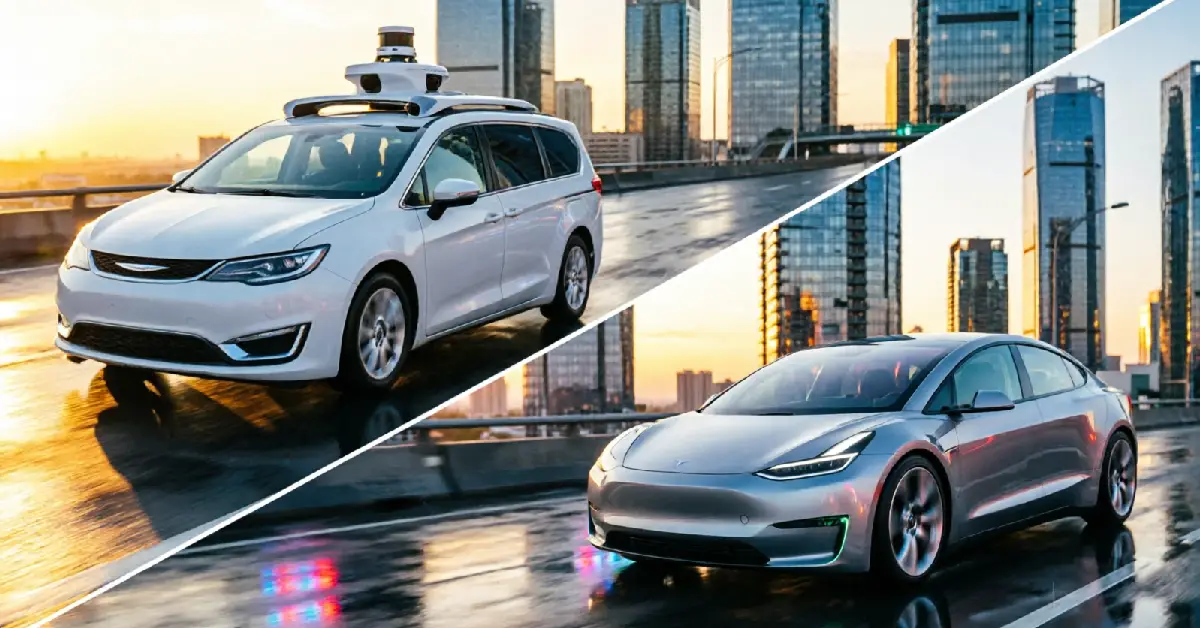
For years, the self-driving car felt like a promise that kept moving further away. In 2026, that’s changing fast. The robotaxi race is no longer theoretical. It’s happening on real streets, with real passengers, in multiple cities across the United States. Two names dominate the conversation: Waymo and Tesla. They’re both chasing the same goal, but they’re taking completely different roads to get there. So who’s actually ahead?
The short answer is Waymo. The longer answer is more interesting.
Waymo Has the Lead, and It’s Not Close
Waymo isn’t just leading the robotaxi race in 2026. It’s operating a functioning commercial business. The company now delivers around 400,000 to 500,000 paid rides per week across 10 U.S. cities, with a target of reaching 1 million weekly rides by the end of 2026. That’s not a pilot program. That’s a business.
The cities currently live include San Francisco, Los Angeles, Phoenix, Atlanta, Austin, and Miami, among others. Waymo plans to open service in Dallas, Denver, Detroit, Houston, Las Vegas, Nashville, Orlando, San Antonio, San Diego, and Washington, D.C. in 2026, with London becoming its first international market. The company is also testing vehicles in New York City and Tokyo.
Every one of those rides is fully driverless. No safety driver. No human backup behind the wheel. That distinction matters a great deal when comparing Waymo vs Tesla autonomous vehicles right now.
The money is following the momentum. In February 2026, Waymo raised $16 billion in new funding, pushing its valuation to $126 billion. Five years ago, analysts estimated Waymo was worth around $30 billion. That kind of growth signals strong investor conviction in the company’s trajectory. Alphabet, Waymo’s parent company, led the round, with prominent venture capital firms joining in.
Waymo’s 6th-generation hardware also helped its cost story. The new sensor suite cut hardware costs to below $20,000 per vehicle, a 50% reduction from the prior generation, and reduced the sensor count by 42%. Critics long argued that Waymo’s LiDAR-heavy approach was too expensive to scale. That argument is getting harder to make.
Tesla Is Building, But Still Catching Up
Tesla’s story in the robotaxi race is one of real progress wrapped in big promises. The company launched its robotaxi service in Austin, Texas in June 2025, initially with human safety monitors in the vehicle. In January 2026, Tesla transitioned to genuinely unsupervised operation in a limited section of Austin, a meaningful milestone for a company that’s been promising full autonomy for years.
The fleet size tells the real story, though. As of early 2026, Tesla operates roughly 30 to 44 modified Model Y vehicles in Austin, compared to Waymo’s fleet of approximately 3,000 vehicles nationwide. Tesla originally projected 500 vehicles in Austin by the end of 2025. That target wasn’t met. Elon Musk’s broader goal of serving half the U.S. population also remains unrealized.
There’s also a safety concern that can’t be ignored. Tesla has reported 15 crash incidents to NHTSA since the Austin program launched in June 2025. Early riders documented incidents including the vehicle driving on the wrong side of the road, phantom braking, and passengers being dropped at intersections. The company redacts crash narrative details, which makes independent safety analysis difficult.
The Tesla Cybercab Is Here, Sort Of
The most significant development on Tesla’s side of the robotaxi race in 2026 is the Cybercab. Tesla began Cybercab production at Gigafactory Texas in April 2026, with 60 units already spotted outside the facility. The first unit actually rolled off the line in February. This is a purpose-built, fully autonomous vehicle with no steering wheel, no pedals, and no side mirrors. It’s designed entirely around Tesla’s Full Self-Driving (FSD) system.
The Cybercab is expected to be priced around $25,000 to $30,000, which would make it the most affordable autonomous vehicle on the market. Musk has described the production approach as similar to consumer electronics manufacturing, targeting a cycle time of one vehicle every 10 seconds at full capacity. He also acknowledged the initial ramp will be “agonizingly slow,” which is a more grounded expectation than usual.
The regulatory picture is the biggest wildcard. The Cybercab cannot operate on public roads until it meets federal regulatory requirements, and as of early April 2026, Tesla has not publicly disclosed which jurisdictions have granted exemptions for a vehicle with no steering wheel or pedals. A fund manager at Future Fund predicted in March 2026 that the Cybercab’s consumer launch could slip to late 2026 due to regulatory hurdles.
On the international front, there was a positive signal. On April 10, 2026, Dutch vehicle authority RDW granted Tesla the first European type approval for Full Self-Driving Supervised, following 18 months of testing and over 1.6 million kilometers driven on EU roads. It’s a supervised approval, not fully autonomous, but it opens a door for Tesla in Europe.
Two Very Different Bets on How to Build an Autonomous Car
The Waymo vs Tesla autonomous vehicle debate isn’t just about who has more cars on the road. It’s about two fundamentally different visions for how self-driving technology should work.
Waymo uses LiDAR, radar, and cameras together. It’s a redundant, expensive sensor approach that creates a detailed 3D picture of the world around the vehicle. Deutsche Bank analyst Edison Yu described Waymo as “furthest along in true driverless deployment,” operating fully autonomous services in high-CAPEX but technically proven urban deployments.
Tesla uses cameras only, no LiDAR, no radar. The bet is that a neural network trained on billions of miles of real-world driving data can match or exceed the performance of expensive sensor arrays. Tesla’s global fleet of owner vehicles represents a training dataset that no dedicated robotaxi company can match, which is a real advantage if the vision-only approach can be made reliable at scale.
Critics argue that cameras alone can’t provide the precision of LiDAR, especially in low light, adverse weather, or unusual scenarios. Tesla’s counter is that its system has seen more edge cases than any LiDAR-equipped vehicle ever could, simply because millions of consumer Teslas are driving every day. The argument won’t be settled by debate. It’ll be settled by data, and 2026 and 2027 will provide a lot of it.
The Race Is Getting More Crowded
Waymo and Tesla aren’t the only players in the 2026 robotaxi race. Amazon-backed Zoox is expanding its robotaxi operations to Austin and Miami, alongside wider coverage in San Francisco and Las Vegas, with a paid service launch in San Francisco planned for the latter half of 2026. Uber is also entering the market with an “Uber-exclusive robotaxi” partnership and plans to operate in 10 markets by the end of the year.
China’s Baidu Apollo Go is scaling fast too. Apollo Go surpassed 250,000 weekly driverless rides in late 2025 and is expanding to Abu Dhabi, Dubai, Hong Kong, and Switzerland. The global autonomous vehicle deployment race isn’t just a U.S. story.
Harry Campbell, author of industry newsletter The Driverless Digest, put it plainly: “Waymo is the only true robotaxi in town right now, though I can see that changing in the next year or two.” Travis Kalanick, the founder of Uber, has also said publicly that Waymo is “obviously” ahead in the autonomous vehicle deployment race.
Can Tesla Close the Gap?
The honest answer is: maybe, but not yet. Tesla’s approach has the potential to scale in ways Waymo’s capital-intensive fleet model can’t easily match. If the Cybercab ramps to real volume production, and if regulators grant the necessary approvals, and if the vision-only FSD system proves reliable enough, Tesla’s cost-per-ride economics could eventually undercut Waymo’s.
That’s a lot of “ifs.” And Tesla has a long record of bold timelines that stretched further than expected. Musk first promised “Full Self-Driving” capability in 2018. He promised a million robotaxis on the road by 2020. Neither happened on schedule. Investors and observers are right to be interested, and also right to be patient.
What’s different today is that Tesla’s robotaxi program is actually running, not just announced. There are real riders in Austin. There’s a Cybercab coming off a production line. There are regulatory approvals moving in Europe. The gap between promise and reality is narrowing, even if Waymo’s lead remains substantial heading into mid-2026.
The Bottom Line
In the robotaxi race in 2026, Waymo is the clear leader by every operational metric: fleet size, cities served, weekly rides, safety record, and investor confidence. It’s a functioning, commercial, fully driverless service operating across the United States.
Tesla is the most compelling challenger, with a bold technology vision, a purpose-built vehicle entering production, and a dataset no competitor can replicate. But it’s still a challenger. The Cybercab needs regulatory clearance. The Austin fleet is still tiny. The safety record needs more miles and more transparency.
The robotaxi race isn’t over. It’s just getting started. The next 12 months will tell us more about who can actually build, scale, and sustain an autonomous ride-hailing business than the last five years combined.

